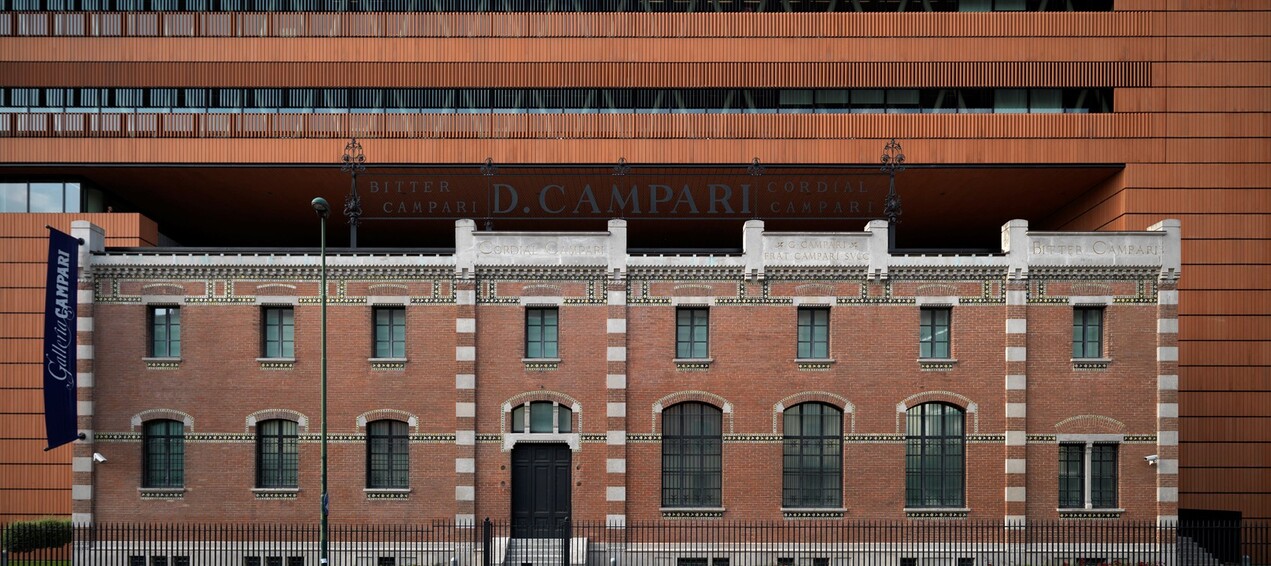
Galleria Campari and the Post-Industrial Revival of Sesto San Giovanni, on the outskirts of Milan
Can art and industry coexist and even talk to each other? In a society that produces (and consumes) objects that can be replicated indefinitely, what role does creativity play?
We often think of the artist in a perhaps slightly outdated Renaissance sense: an isolated genius capable of translating aesthetic models into unique and rare pieces.
However, art also has the ability to inspire the shapes and colours of manufactured objects, to serve industry, and to combine beauty with utility. This was the role of art according to the Arts and Crafts movement.
Attempting to move beyond the usual distinction between the uniqueness of a work and the replicability of a commercial product laid the foundation for a new discipline that emerged over the last century: design. This discipline sees graphic designers and model makers collaborating to create objects that are both harmonious and functional. In 1919, the Bauhaus, the first school of arts and crafts, was established in Germany.
Among the earliest advocates for the integration of art and business in Italy was Davide Campari. The son of founder Gaspare Campari, who had started his liquor business in 1860 in Piazza del Duomo, in the centre of Milan, Davide established the first factory for the industrial production of Campari in Sesto San Giovanni in 1904. A great entrepreneur, Davide Campari was also a marketing visionary and immediately devised an avant-garde communication strategy, entrusting artists of the Belle Époque, and later Futurism, with the creation of prominent promotional campaigns for his drinks. Decades of collaboration with Italy’s creative elite helped this Milanese company establish itself in the collective imagination as the quintessential Italian aperitif.
Today, preserved and exhibited at the Galleria Campari, posters, playbills, calendars, and advertising graphics from the 1930s to the 1990s not only recount a century of company history, but also stand as testimonies to the successful marriage of art and business.
Galleria Campari
Open since 2010, Galleria Campari is an unconventional exhibition. Located within the old factory, which remained in operation until 2005, the Gallery spaces feature a blend of installations, interactive videos, graphic creations, and cult objects such as bottles, glasses, and a wide range of merchandise. The production techniques and chemical composition of the drinks take a backseat, and the focus is on the communication, modern culture, and design that have propelled the brand to global success.
The Gallery’s rooms are adorned with works by notable artists from recent history, dedicated to the brand. Among the prominent names are Marcello Dudovich, Leonetto Cappiello, Fortunato Depero, Guido Crepax, Bruno Munari, and Ugo Nespolo – leading figures commissioned by Davide Campari to develop the company’s advertising. The result is a collection of posters and billboards that, at the turn of the century, earned their place in the annals of history, cementing an enduring image of success. In the 1930s, Fortunato Depero introduced futuristic forms to bars across Italy, creating posters and designing the iconic Campari Soda bottle – the first single-serve aperitif – shaped like an inverted goblet. Bruno Munari, in 1964, crafted the “Graphic Interpretation of the Name Campari,” the first billboard displayed on the walls of Milan’s newly inaugurated underground system.
Equally successful was Campari’s association with television and cinema, from the Caroselli (short advertising programmes) broadcast between 1957 and 1977 and featuring beloved public figures, to TV commercials, including one directed by an initially sceptical Federico Fellini. More recently, directors like Paolo Sorrentino, Stefano Sollima, and Matteo Garrone have contributed their talent to the ‘Campari Red Diaries’ narrative series, creating three short films of remarkable merit.
Industrial architecture also played a central role. Davide Campari ensured that production sites embodied a thoughtful blend of beauty and functionality. The façade of the original 1904 factory, designed in the Liberty style with floral ceramic tiles, has been seamlessly integrated into the modern Campari headquarters, inaugurated in 2009 and designed by Mario Botta and Giancarlo Marzorati. The guiding principle is the repurposing of industrial spaces, which today take on new functions. This is certainly not an isolated case in Sesto San Giovanni, where efforts have been underway for years to repurpose and revitalise disused factories and industrial sites.
Ex Breda Industrial Archaeological Park and Sacchi Archive
A city, symbol of the proletarian movements, which then fell victim to the crisis in heavy industry, Sesto San Giovanni was also home to the Breda factories, a company that operated in the metalworking and steel sectors. These vast spaces have found a new purpose thanks to a comprehensive redevelopment project. Among trees and meadows are workers’ residences, converted warehouses, towers, and even an old locomotive: historical testimonies of industrial archaeology. The imposing steel vault of the Carroponte dominates the complex; here, exhibitions and large concerts attract the Milanese to new social spaces.
Not far away, on the edge of the Ex Breda Park, the Spazio MIL – Museum of Industry and Labour houses the Giovanni Sacchi Archive. Sacchi was another proponent of beauty applied to mass production. He was also a key model maker and a reference point for generations of creative talents. Many of the ideas conceived by Italian designers were brought to life through his three-dimensional models, which transformed design sketches into tangible forms. Very often, Sacchi found himself in the space between words and action.
Pirelli Hangar Bicocca
The first encounter with HangarBicocca is unexpected and engaging: seven lead and reinforced concrete pillars, designed by Anselm Kiefer, stand motionless in the centre of a gigantic closed – and empty – space.
The installations, whether permanent or temporary, create a profound connection with the repurposed spaces (formerly Breda) that house them. A short distance from its headquarters, Pirelli has been collaborating since 2004 with major figures in contemporary culture, who have permanently placed HangarBicocca on the city’s map.
Content cannot exist without a container. The space, formerly dedicated to the production of agricultural machinery, airplanes, and railway carriages, is now a space for the creation of meaningful experiences, where innovative projects interact with industrial archaeology. This further demonstrates the coexistence of art and industry – and how they enrich one another.